Thursday, November 8, 2012

MY DADDY, CECIL KILGORE & CLOTHES


It is astonishing how we associate clothes with a person, especially someone who is dear to us.  All manufactured clothes come from a supplier and are displayed in stores with no attachments to people.  They are there for anyone to purchase.  But after clothes receive an owner, they become personal property and a part of the identity of the person who owns them.  This is so evident when, after the death of people we love, we deal with, in some fashion, the importance of their clothes.  A perfect example of this occurred around the time of my daddy’s death in April of this year. 

A week before Daddy’s death in April of 2012, I was visiting my parents, which I did more frequently since my retirement.  When I visited by myself, I usually arrived in time for breakfast.  For this particular visit, I had left Birmingham very early on a chilly spring morning that required some kind of jacket.  I had recently purchased from Wal-Mart a plaid jacket with a hood, for the ridiculously low sale price of three dollars—quite a bargain!  It served its purpose well that morning, keeping me warm as I left my home before daybreak.


When I arrived at parents’ house, we had our hugs and greetings, and then I took my warm jacket off, and placed it in a chair against the wall next to the piano.  We had a wonderful breakfast as always, and then I helped Mother with the dishes and cleaning up the kitchen.  Daddy returned to his easy chair in the living room.  Eventually, I went into the living room and sat on one end of the couch opposite Daddy.  We did our usual small talk while Mother went to the back part of the house to get ready for a doctor’s appointment in Jasper.  During my conversation with Daddy, I got up from the couch and went to the chair where I had placed my new Wal-Mart jacket.  Bringing the jacket to Daddy’s chair, I proudly showed him my new purchase.

He loved the jacket and could not believe I got it for just three dollars!  He was truly impressed.  Personally, I don’t know if he was more impressed with the jacket, or with the price.  Daddy was always a bargain hunter.  He liked the jacket so much that I offered it to him as a gift.  In true Cecil Kilgore fashion, he told me he did not want to take my jacket.  I explained that I had also purchased another coat at the same time, and didn’t really need two.  He still would not accept the jacket.  Instead, as Mother came into the room, the first thing Daddy said was, “Beat, I want you to go by Wal-Mart and buy me a jacket like Johnny’s!”

Daddy and I had a good day together while Mother was gone, as we talked about different things.  I cherish those talks. I can’t remember all the things we talked about, but it was on that occasion that Daddy shared with me about the bronze foot marker he wanted on his grave.  He shared at length what he wanted the marker to say.  He wanted me to take care of it when he died.  He said the Veterans Administration would furnish the marker at no charge because of his service in the army during World War II.  I wrote down on a small piece of paper what Daddy wanted on the marker. Then I carefully placed the slip of paper into my billfold. I could not have believed that day that it would be very soon that I would be taking that paper out and doing just what Daddy had charged me to do.

When Mother returned that afternoon from Jasper, without a plaid jacket from Wal-Mart, she told Daddy that she did not see any jackets on sale.  I stayed around a little longer that afternoon, so I could also have some time with Mother.  When it was time to leave, I told them that I would plan to be back the following Tuesday.  Before I left, as I said goodbye to Daddy, I said, “ I’m going to leave you the jacket.”  He accepted.  As we said our goodbyes, Mother said, “Don’t forget your jacket.”   Daddy responded, “Johnny is going to leave it here for me.”  As I went out the door, I assured him again that I had purchased another one, and did not need the jacket, and that I would see him next week. 


I returned the following Tuesday to visit my parents, and the jacket was still lying in the chair where I left it the previous week.  We had a good visit that day, but a short one, because I was traveling from Nauvoo to Oneonta, Alabama to begin a singing tour with the Alabama Singing Men.  (I have been a member of this organization, made up of Ministers of Music from Baptist churches throughout the state, since its creation in 1973.) The tour was to begin on that Tuesday in Oneonta, and continue through Thursday, with the final concert being at Central Baptist Church in Decatur, Alabama.  Immediately after that final concert in Decatur, I had a voicemail on my cell phone.  It was from my brother, Ricky, asking me to call him.  There in the parking lot of Central Baptist Church, I returned the call. When I got Ricky, he simply and sadly told me that Daddy had passed away.  Perhaps never before had I had such a feeling of disbelief.

The family was all meeting at Mother’s for the night.  Since I was in Decatur, I went directly to Nauvoo from there without going home to Birmingham.   It was long and sad drive.  Upon arriving at Mother’s, it was evident that she had been surrounded by family, friends and neighbors who were all at the house.

During the next two days, we made the arrangements for Daddy’s funeral, which would be held on the coming Sunday. After everything settled down, and we had time to reflect, I noticed the plaid jacket in the chair where I had left it.  A week after Daddy’s funeral, I took the jacket, as it had become a kind of symbol of those last days with my dad. 

During these chilly fall days, I proudly wear my plaid jacket, purchased from a Wal-Mart sale rack. It still serves as a memory of my father and I wish so much that he was here to wear and enjoy the plaid jacket he had liked so much. Whether it was bought for three dollars or one hundred and three dollars, the jacket is worth more than any amount of money to me now.

During the first month after Daddy’s death, we took all his clothes and stored them in the upper house that Mother and Daddy owned.  A few weeks ago, on Friday, October 26, 2012, Mother and I took them to Main Street Ministries in Double Springs, Alabama, where they can offer them to the less fortunate. I was grateful that Daddy’s clothes went to a good cause. 

Front Entrance to Main Street Ministries
Double Springs, Alabama

Workers at Main Street Ministries
(From left to right)
Dorothy, Jim, and Jewell
Daddy would have been pleased that they are available for the people of Winston County, where he worked for so long.  But giving those clothes away was an emotional and difficult thing to do.  Many of our Kilgore cousins have had to experience those same emotions because all the children of Virge and Sarah Kilgore are now gone.  Everyone grieves differently, yet all things are in common.  Such is the importance we place on our loved ones’ things—especially, their clothes.

Johnny Kilgore

EDITED COMMENTS:
I just heard from Daddy's oldest grandson, Shane Kilgore in response to this posting just a few hours after my initial post.  I thought it would be appropriate to edit the article with Shane's thoughts and a picture he send me.

Hey Johnny I read your blog about the jacket. I loved it I just wanted to share this picture of papas jacket that Mema gave me. I have not even worn it yet I don't want to mess it up it's the only thing I have that belonged to him. I believe it was his army jacket can you confirm that for me. I love him and miss him. 

Shane Kilgore

I wrote Shane back in appreciation and told him that it was a great looking jacket.  Also, told him I wasn't familiar with the jacket because Daddy had so many clothes.


Friday, November 2, 2012

CECIL W. KILGORE'S STATUE OF THE NAKED LADY


As a child growing up in a rural environment, we accepted with simplicity the things of nature, the things of family, the things of God, and the things of life in general.   That time was the 1940’s and the 1950’s. The place was a rural country setting, five miles from Nauvoo, Alabama. 

Money was scarce, but love abounded.  Meals were simple. Food came from what was raised on the farm, sprinkled with a few rations from the government, and some staples purchased from a local grocery store.  Clothes were hand- made by a loving mother—shirts made out of flower sacks and blue jeans purchased from the Jasper Fair Store.  Life was the same for everyone during those struggling, but happy days.

We were a Godly, conservative family who worked hard and played hard.  Our playmates were more than friends.  They were our first cousins.  My dad was so conservative and strict that he did not allow playing cards in the house.  He also did not permit movie theater attendance, nor social functions when the locations were questionable.  My dad did not swear or curse.  He did not smoke, nor did he drink.  He lived to a very high standard.  Self- control and discipline were at the very fiber of my daddy’s being.  He was clean- cut and reliable—steadfast and sure.  He also instilled and enforced strict discipline in us.  He was a perfect example of a good man in every sense of the word.  He was of the highest character. 

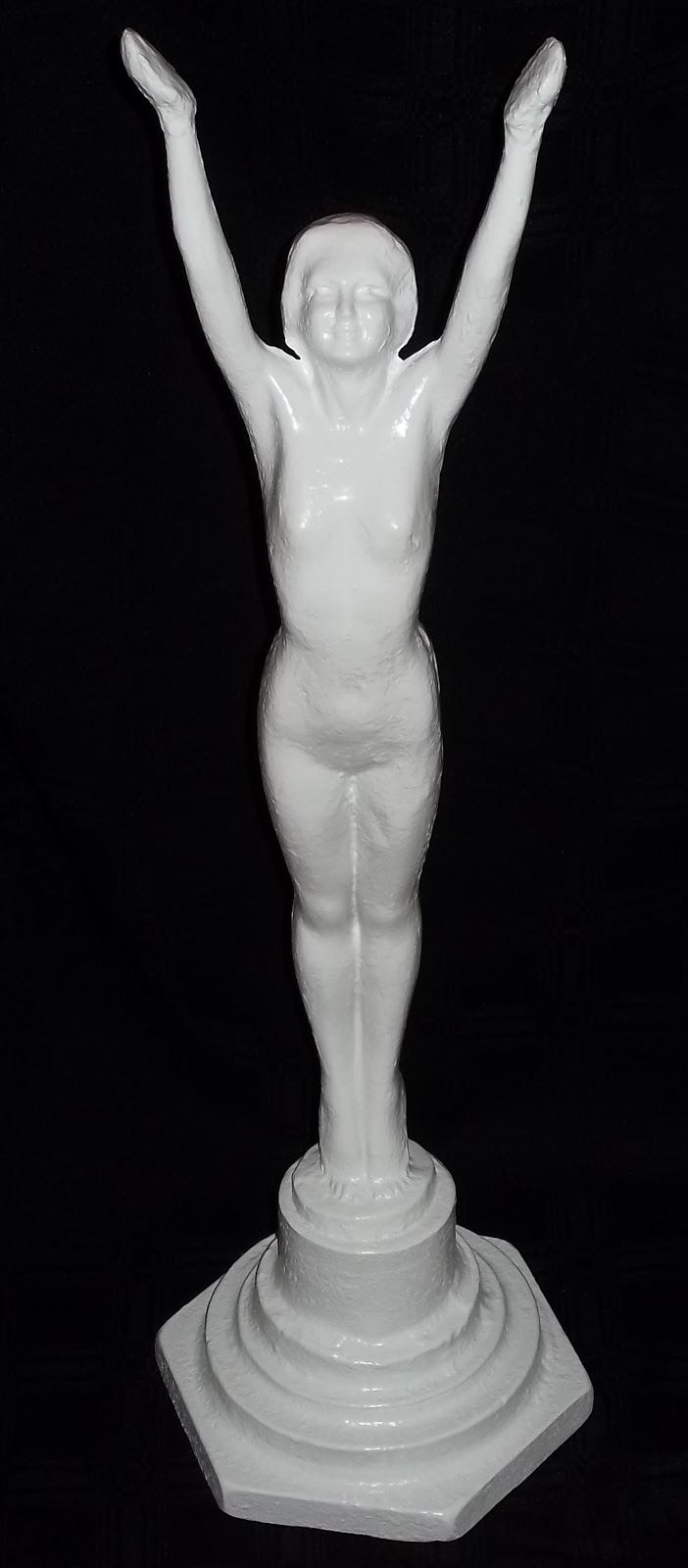
I say all that to say this:  There was a statue of a naked lady in our home!  Having such a statue certainly did not fit the picture of my dad as I have described him.!  He would not have permitted any “girly” magazines or any questionable pictures.  Then why the naked lady standing erect and tall on her tip toes, pointing her hands to the heavens as she propped open our front door?   We always made fun of the statue of the lady.   But as we grew older, we understood that art statues typically are showing the beauty of the human form. At the same time, when the pastor visited us, the statue of a lady was quickly removed from the living room to a place out of sight.  I am sure it was out of respect, or maybe we just did not want him to think any less of us.  Thinking back on it, it is humorous remembering how we scurried about hiding the white, little naked lady.  This still does not answer the question of why the statue was part of our home’s décor.    

This is how it all came about.  When Daddy graduated from Winston County High School in 1940, he went to Birmingham to find work. During that time, he lived with his sister Ruby and her husband, Johnny Chadwick.  Daddy got a job at Continental Gin Company, located at 4500 5th Avenue, South in Birmingham, Alabama 35222.  (Of course, back then there was no zip code indicated the area of the city.) 
Old Photograph of Continental Gin during its prime

Continental Gin was located in the East Avondale area of the city where US 78 intersects 5th Avenue, South.  The company was extremely large, having multiple structures on 170 acres of land.  It was an industrial facility with a major presence in the city.  It was founded in 1925 and was going strong in the 40’s because it was an authorized, federally funded facility during World War II.  The company’s original business was that of making cotton ginning machinery.  But during the war, the company produced rocket bodies for the Navy, and also fuses and projectiles.   Daddy’s first job was working in the foundry of Continental Gin.   
  
(As a side note, Continental Gin is no more.  The Continental Gin property is presently on the National Registery of Historic Places (1980) and is an industrial park for industry, processing and extraction.  It also has 14 different structures.  I have included some photographs of the buildings in their present condition.)

Present Site Sign

Hill Building (main building next to US 78)

Breeze Way Entrance to the Plant

Open Building in back portion of property

Building K

Building J

Side View of multiple sections of old Continental Gin

Inner Core of the old facility with multiple buildings

Building F next to Parking Lot
Sign directions to the 14 different buildings

Front building and ramp from the Parking lot


In March 1942, Daddy married my mother, Beatrice Manasco .  Daddy was still working at Continental Gin.  He and Mother moved into a rented duplex house in Eastlake, near 77th Street and off of First Avenue, North.  Daddy was deferred by the military because his employment at Continental Gin was considered strategic to the war effort. 

Because Daddy was developing sinus problems working in the foundry, the company transferred him from the foundry building to the machine shop plant.  But before Daddy left the foundry, he cast in iron, a statue-- a nymph—the naked lady looking up toward heaven with hands and arms raised high.  To keep the statue from rusting, it was painted white.   The city of Birmingham, Alabama had its fifty-six foot cast-iron statue, Vulcan, and Cecil Kilgore had his twenty-six and half inch cast-iron statue, the naked lady.

As my daddy continued working and breathing the polluted air of Continental Gin and of  the city itself, his sinuses grew worse and worse.  His doctor advised him that in order to get better he must change settings.  That meant quitting his job at Continental Gin and leaving Birmingham to return to Nauvoo, Alabama.

Daddy did just that.  Mother and Daddy moved into a small four room house across the hollow from the place where he was reared.  It was in that small frame house that I was born in December 1944.  My mother still lives in that same house, although it has been renovated and some rooms have been added.  Because Daddy had returned to the farm, he was no longer in an occupation were he would be deferred from serving during the war.  He was drafted in 1945, soon after I was born.  World War II ended about the same time he completing his basic training.  Daddy was honorably discharged, not having to go over seas. 

The only token of Daddy’s life and work in the city before he was married, started a family, and served his country, is the white, little naked lady.  It is an example of 1940’s statuary, but it is more than that to me.  It is a special art piece that my daddy made. 

What has happened to the naked lady statue?  A few years ago, Daddy gave it to me.  I had planned to repair a missing hand and to make it look new with a fresh coat of white paint.  My efforts were not successful, so the statue went to the basement, hidden away.

Recently, I posted on our Kilgore Cousins blog about two clocks that were in the Kilgore family—a Little Ben clock owned by Daddy’s brother, Johnie Kilgore, and a Big Ben clock owned by Daddy’s sister, Sis Kilgore Romans.  In response to that post, my first cousin, Joe McKeever, e-mailed me about his remembrance of the naked lady statue in our home during his growing up years.  I wrote him back, telling him that the statue was in my possession and that I planned to refurbish it.  As a result of that exchange, I went to work a few weeks ago on the lady that adorned our living room during my childhood.  I now can say that little naked lady is restored to her former glory, all thirty-one pounds of her.  I share with you some photographs of her taken from various angles.


The statue was the object of laughter when we were children.   The statue was an object of embarrassment as a teenager.  The statue was an object to be forgotten as a young adult.  As a senior adult, the statue has become an object of value, not for its vintage artistic worth which I do appreciate, but simply because of who made it.  It now proudly serves as a doorstop in the den at our house.  My wife is trying to adjust….and I anticipate interesting reactions when the kids come home for Christmas! 

Johnny Kilgore 


Monday, October 29, 2012

GRANNY KILGORE...Bridges, Storms, Dogs, Cooking, & Singing


Memories may be recalled, but many times they veil themselves as if in an early morning fog, which shifts and disappears as the sun appears.  Some memories are capsules of a single occurrence, locked in the storage of one’s mind.  Such is the case with three distinct memories I have of Granny Kilgore.  Each memory is fuzzy at best, but at the same time; clear enough to have a still -shot colored photograph of it in my mind’s memory chip. 


But before I share my three Granny Kilgore still- shots, my first cousin, Ronald J. McKeever, recently sent me some memories he has of Granny Kilgore, which he wanted to share with everyone:


Our Granny Kilgore feared bridges and crossing water.  Many times when they would travel by mule and wagon to Nauvoo, they had to cross Blackwater Creek, over a one-lane metal structure bridge, laced with wooden boards.  Oftentimes, the mule would balked about crossing and Granny Kilgore always insisted on getting off the wagon and walking across the bridge after the wagon had crossed.


When we McKeevers moved back from West Virginia in 1951, it became my duty to travel with Granny when she would go somewhere to spend a night or two.  On one occasion, we were going to visit Ruth and Ted, who had recently moved to Guntersville, where Ted had become Forest Ranger for Marshall County.  This trip involved catching the bus in Double Springs and going through Cullman, Arab and into Gunetersville.  Guntersville is on an island and from Arab, you cross the causeway, which is about two miles and crosses a couple of bridges.  Granny insisted that I instruct the bus driver that she wanted to walk across, rather than ride the bus two miles to the shoreline.  I assured her that the driver had done this many times and he would not let her off that far away from the bus station.  I am not sure but I think she held her breath and prayed for the two miles until we reached the other side.  We did make it safely both ways.


I appreciate Ronnie capturing a part of Granny’s personality that we may not have known, or may have forgotten.  I also remember Granny Kilgore being extremely fearful of storms.  Many people are, but she was to the point of having an anxiety attack any time a storm hit.  I often wondered what might have occurred in her younger days that made her so fearful. 

I can also recall Granny Kilgore being so fearful of a family pet dog we owned when I was a young child.  It was a beautiful, English bulldog.  One day Granny was baby sitting us in our home while mother and daddy went somewhere.   For some reason, Granny had to go outside to the backyard, where she encountered the bulldog, which could sense her fear, resulting in the dog attacking her.  She got away, but not without having some flesh taken from her legs.  When Daddy got home and saw his mother hurt from the dog attack, with angry justification, he grabbed his shotgun and went out the back door.  Not long after, we heard the loud blast of the gun. As mother explained the reason for Daddy's actions, he was outside burying the dog.  It was such a sad time because Granny was hurt and our pet was dead.

Now I begin the stories of my three still- shot memories of Granny Kilgore.  The first one is the fuzziest memory, but it involves a summer revival at the church our family attended in Nauvoo, Alabama.  New Oak Grove always had a two-week summer revival in June with services both in the morning and the evening.  It was a special time when people could host the guest evangelist for lunch.  Granny Kilgore was doing just that.  She had the preacher, the guest evangelist, and my family there to enjoy her cooking. Granny had cooked quite a spread on her wood-burning stove.    The round table holding all the food was in the same room where she had prepared the food.  (As a side note, that table is presently our main table in my home. I had it restored when I lived in Wetumpka, Alabama more than thirty years ago.  The chairs that went with the table have never been restored.   They are still in Granny Kilgore’s house, and I hope to restore them someday.)  


Now back to my story.  Granny Kilgore had been cooking all morning.  There was so much food that there was little room to sit around the table, but all the adults did just that.  The adults ate first.  I  can recall going into the kitchen, seeing all that food, and wishing for the pulley bone.    I was told that I could get what was left over after the adults had eaten.  We had to eat in shifts, and when it was time for the children, there was no pulley bone there to enjoy.  In fact, there was no chicken left at all except for the wings.  Needless to say, I was a disappointed kid.


My second still-shot memory is also in a kitchen, but it was in Granny Kilgore’s newer kitchen, the one off her bedroom and living space.    The newer kitchen was originally an enclosed back porch that was converted into a modern kitchen with a big white sink connected to running water, an electric Frigidaire stove and refrigerator, and a rectangular red table off to one end. 

The small kitchen was narrow with a slanted ceiling, but at the same time, very long. The slanted ceiling had Celotex tiles and the wall was painted with  two colors, white on top and a bright off- green on bottom.  It was very modern in contrast to the rest of the house.  In that room, I recall, in living color, having Granny Kilgore’s cat head biscuits.  The are called “cat head” biscuits because they are as big as a cat’s head.  Granny’s Kilgore’s biscuits may have been even bigger than a cat’s head because they were enormous.  They were also good! Oh, so good, especially with Golden Eagle syrup.

Granny Kilgore also took great pride in making what she considered a good hot chocolate drink.  Although I drank it, I had to pretend to enjoy it so I would not hurt her feelings.  The drink was made with a large amount of water, very little milk or no milk at all, and some cocoa with sugar.  It was very watered down, and not creamy and rich at all.  She never knew I didn’t care for it. At the same time, I so appreciated the love she displayed by taking time to make her hot chocolate for me.


The third picture memory of Granny Kilgore is of her sitting in her big rocker in the corner of her bedroom near the fireplace, while I sat on a stool next to her.  In her hand was a songbook of church hymns.  She opened the book to one of her favorite hymns and sang      “Nearer, my God, to Thee, Nearer to Thee!  E’en though it be a cross That raiseth me!  Still all my song shall be, Nearer, my God, to Thee!   Nearer, my God, to Thee, Nearer to Thee!” 
(Words by Sarah F. Adams and Music by Lowell Mason)  
She would tilt the songbook closer to me as she had me to sing along with her.

Now, many years later, I’m still singing those old hymns, and I know Granny is doing the same up in Heaven.  While writing this post, I’m actually singing, “Precious Memories.”  Granny is singing near to God in Heaven!  And for her, there is no more fear…. of narrow bridges, crossing water, facing storms, and certainly no fear of aggressive dogs.

I sign off now as Granny Kilgore's grandson, Johnny Kilgore.


Monday, October 15, 2012

CLOCK REMEMBRANCES IN THE KILGORE FAMILY


Johnie Thomas Kilgore, son of Virge and Sarah Kilgore of Nauvoo, Alabama, was the middle child of nine living children.  His youngest brother was my father, Cecil Kilgore.  Johnie’s life was cut short by a freak motorcycle accident in March 1939.  Everyone who knew Johnie Kilgore spoke his name with a special reverence.  Though I was not born until long after his death, I knew of him in so many ways.  One of those ways was through a little timepiece belonging to the uncle I did not know.  That little clock was always in our house as I grew up.

The clock is a Westclox Baby Ben, Style 4, manufactured between1934 and 1939.  Johnie’s clock was purchased, at the earliest, in late 1936.  The reason I know that is because it was not until late1936 that the wording on the dials was changed from “Made by Western Clock Co.” to read “Made by Westclox.” Based on research, the base cost of the clock when it was manufactured was $2.95.  That was a lot of money during the 30’s. 

The case of the Baby Ben style 4 is a modification of style 3.  There is no matting ring between the dial and the glass, and the base has two convex curves (one on each side) instead of four concave curves.  The glass is convex.  Baby Ben style 4, when introduced in 1934, came in two case colors.  The ivory case with brass trim had a white non-luminous dial with black figures, or a brown-banded luminous dial.  The black (actually called gunmetal, a grayish metallic paint) case with nickel trim had a white non-luminous dial with black figures, or a solid black luminous dial. The key to wind the alarm was lower on the back than on style 3, and there was a sliding cover on the regulator slot, which was also used on styles 5 through 8 that followed.   Another interesting note is that in Style 4, the numbers, 9 and 6 used a curved tail, while in later styles those numbers had a straight tail. Also the word, “Westclox” is smaller than the words  “Baby Ben” on the Style 4 clocks. The base identification number is 61N.   Johnie’s clock used a loud alarm instead of a chime alarm, which was distinguished as Style 4 A.

Here is a photograph of Uncle Johnie’s clock in its present condition.  As you can see in the picture, the gun metal black has worn off through the years, leaving the nickel metal exposed.  Originally, only the nickel rim would have been exposed along with the back, and the case would have been totally black.  You can see some of that black on the base in its present condition.  

In my childhood, clocks and watches were not common items as they became in later years.  I always felt Johnie’s clock was special because of who owned it.  It was part of Uncle Johnie’s life and so it became part of our lives.  It was of the old guard of clocks because it was strictly mechanical.  It had to be wound daily, otherwise, it would stop.  I remember the Baby Ben with the black face moving about the house depending on who needed it.  I believe that the clock accompanied me to band camp in my teenage years.  It was rare that the clock ever left the house because it was guarded carefully.  It held special sentimental value.  That value has not decreased in any way through the years.  When Mother gave me the clock, it would not work.  I recently took it to a clock smith to have it repaired.  It works fine now!

Strangely enough, I also have in my possession a Big Ben clock, which belonged to Lou Etta “Sis” Kilgore Romans, the oldest sister of Johnie Thomas Kilgore.  Sis was 7 years older than Johnie.  For many years before her marriage to Jerdy Romans, she was like a second mother to her younger siblings.  After Sis’ death on April 10, 1986, some of her possessions were willed or given to her siblings. Among those was a Westclox Big Ben clock, which was given to my daddy.

The clock itself holds no family memories as Uncle Johnie’s clock did.  But it is still special because it does serve as a remembrance of a wonderful aunt.   On the base of the clock is a tag which reads “ Strickland Rexall Drug Co.” and in pencil, the price of $9.25.  The clock itself is a stylish modern 60’s looking clock.  In my research, I discovered that Aunt Sis’ Big Ben is a white style 8 Big Ben alarm clock with brass trim and non-luminous dial.  It was initially introduced in 1964 and was discontinued in 1980.  The initial retail was $8.98.  Just like Uncle Johnie’s clock, it is spring- loaded and must be wound each day.  Sis’ clock still works and did not need any repair.  Here is a photograph of the clock for you to see.

Some of the factual information about these two clocks was found on the internet and I acknowledge the sources at this time: Westclox-An Identification and Price Guide, Gary Biolchini, Schiffer Publishing, 2003, ISBN 0-7643-1835-7; The Westclox Big Ben and Baby Ben Identification Guide, Richard Tjarks and Bill Stoddard, revised edition, 2011.
These two vintage timepieces are a link to the past and certainly stir the imagination about the lives of those who owned them.  If the clocks could talk, there would certainly be stories to tell.  These clocks serve as a reminder that time moves on. At the same time, because of their ties with our loves ones, they also serve as a token of the lives lived.  They are special keepsakes.
In Ecclesiastes, Chapter 3 there are some familiar verses that tell us of the mystery of time.  I conclude this post by quoting the opening verse.  "There is an occasion for everything, and a time for every activity under heaven."(Christian Standard Bible).  So goes this blog post activity as I share with you an occasion to look at two clocks belonging to our Kilgore ancestors.  Just remember that in His time, God makes all things beautiful and He does not even need a clock. 
Johnny Kilgore


Monday, October 1, 2012

REMEMBERING OUR KILGORE RELATIVES BURIED IN CEMETERIES AWAY FROM OUR NAUVOO ROOTS


Many of the descendants of Virge and Sarah Kilgore are buried in three cemeteries near the communities of Nauvoo and Poplar Springs in Winston and Walker counties in Northwest Alabama.  Previously, I featured each of these cemeteries in a blog trilogy, displaying photographs of the gravestones of those buried at Old Bethel, Bennett, and New Oak Grove.  This post is very similar, but features other cemeteries outside the three already mentioned.   

There are four specific areas of Alabama where some of Papa and Granny Kilgore’s descendants are buried that do not involve the Nauvoo perimeter.  Those locations are Jasper, Clanton, Sheffield, and Albertville.  Our relatives who are buried in those locations lived and worked there, or in some cases, moved there to live out their retirement years.

Jasper is the closest location to the Kilgore farm in Nauvoo.  The city of Jasper, though small in comparison to the metropolitan area of Birmingham, always was a major city for local commerce.  It is only approximately 18 miles away from the Kilgore old home place.  The relatives who lived and worked in and around Jasper were, for the most part, from the Dolly Kilgore Gordon Sherer family.

Aunt Dolly and Uncle Jack were very active at New Prospect Baptist Church in Jasper.  Jack was a top-notch carpenter and he had much to do with the building of the present sanctuary of New Prospect.  Uncle Jack was Dolly’s second husband.  Her first husband, Johnny Gordon, died in l929 at the very young age of 25. There were two children born from that marriage, James Gordon and Jacqueline Gordon.  All these precious family members are buried in two separate cemeteries on Alabama Highway 5, just north of Jasper. These cemeteries are located on either side of New Prospect Baptist Church.  the older cemetery was church established and eventually owned by the city of Jasper and the other  cemetery is privately owned.  

Aunt Dolly and Uncle Jack are buried in the cemetery established by New Prospect Baptist Church.  New Prospect Cemetery has its annual decoration day on the second Sunday in May.  Uncle Jack and Aunt Dolly loved their church and loved serving their Lord there. My sister, Rebecca Kilgore Smith, is serving the very same church today as Music Director.  I know Aunt Dolly and Uncle Jack would be proud.

 I can recall, as a teenager, one visit in Aunt Dolly and Uncle Jack’s home when Uncle Jack and Aunt Dolly talked about how important it was to tithe.  They lived out their faith through service and by giving the Lord his tithe.  That really made an impression on me.  Aunt Dolly played the piano and played it quite well.  When my family visited in their home, she always sent me to the piano that was located in the parlor to hear me play. Mother recently found a cassette tape recording of Aunt Dolly playing the piano during one visit.   Aunt Dolly was a terrific cook, and I also recall some wonderful meals around her table. These are great memories.  How fitting that these two are buried in the cemetery founded by the church where they invested their lives.  I honor these two Godly people now as I show photograph of their gravestones.


The other cemetery adjacent to New Prospect Baptist Church is called Walker Memory Gardens.  This cemetery does not allow upright grave markers.  Instead, the markers are flush with the ground.  There are many inscriptions in bronze on slabs of large granite.  We have many cousins and/or their spouses buried in this cemetery.  They are descendants of Dolly Kilgore Gordon Sherer.

I would like to list them now, mentioning their relationship to Dolly and honoring them by displaying their gravestones.

First, there is Johnny Gordon, Dolly Kilgore’s first husband and the father of James and Jacqueline Gordon.  He was born in September 1903 and died in May 1929.  Dolly was 20 years old when her first husband, Johnny, died.  Dolly's daughter, Jacqueline was 2 years old and her son, James was  6 months old when their father died.


There is Dolly’s son, James Gordon, Sr., who was born in November 1928 and died February 1999.  James’ wife, Mildred, is buried next to him.  Mildred died in January of 2012.


There is Dolly’s grandson, Johnny James Gordon, who was the oldest son of James and Mildred Gordon.  Johnny died in 2001 at the age of 51 years old.


There is Dolly’s oldest child, Jacqueline Gordon Cordes/Gentry, who was born in May 1927 and died in February 2007.   “Jackie” is buried next to her daughter, Patti Cordes Lawson, Dolly's granddaughter who died at the age of 42 years.  Next to Patti is her father and Jackie's first husband, Ruben Cordes.  Ruben died in 1974.


Alan Dale Sherer, Dolly’s only child by her second husband, Jack Sherer, has a grave marker in Walker Memory Gardens where his first wife, Carol, is buried.  Carol died in July 2003.


Now let us travel from Jasper to Clanton, Alabama where Ruby Kilgore Chadwick lived. Ruby and her husband, Johnny, moved to Clanton after retirement to get away from the big city of Birmingham.  Clanton is located in Chilton County, in the middle of the state.  Ruby and Johnny were active members of Concord Baptist Church, located just off of I-65 just north of Clanton.  Ruby and Johnny are buried in Concord Cemetery next to the church.   The address is 1184 County Road 28, Clanton, Alabama. Uncle Johnny died in 1993 and Aunt Ruby died in 2001.    I honor them now as I display a photograph of their gravestone.


Aunt Ruby and Uncle Johnny were wonderfully precious people who lived a full life raising three brilliant and beautiful girls and one older intelligent son, Dr. William Raymond Chadwick who we called “Billy” or “Bill.”  Billy was a chiropractor whose practice was in Clanton, Alabama.  He raised his family there, and Billy’s two daughters, Leah and Rachel, still live there raising their own families.  Billy died in July 2009 and is buried in Martin Memorial Cemetery.  The cemetery is located on Yellow Leaf Road in Clanton, Alabama.  I honor him now as I display the photograph of his grave marker.


We now direct our attention to the Sand Mountain area of north Alabama, where Virge and Sarah Kilgore’s daughter, Ruth Kilgore Spain and her husband, Ted, lived, retired, and died.  Ruth and Ted have some children and grandchildren who still live in the area.  Ruth and Ted Spain are buried in Marshall Memorial Gardens, 3368 Highway 205 North, Albertville, Alabama 35950.  The special Decoration Day for the cemetery is the fourth Sunday in May. The area also holds a special place in my heart because my sweet wife, Pat Colvin Kilgore, is originally from Albertville.  Her parents are buried in the Memory Hill Cemetery there.  I honor my Aunt Ruth and Uncle Ted now by showing a photograph of their grave marker.


From Albertville we move to the extreme northwest corner of the state, the quad-cities of Florence, Tuscumbia, Muscle Shoals, and Sheffield.  Papa Kilgore’s oldest son and his wife, Grady and Nettie, retired in the area because their three children and grandchildren lived in the area.  Grady and Nettie are buried at Colbert Memorial Gardens, 502 Montgomery Avenue, Sheffield, Alabama 35660. 
I honor Grady and Nettie now by showing a picture of their grave marker.


Jimmy Kilgore, Grady Kilgore’s middle son, has two loved ones also buried at Colbert Memorial Gardens.  They are his first wife, Wanda, and their son, Donald Trent Kilgore.  Donald was born on September 10, 1979 and died two days later.  Wanda died May 21, 2005.   I honor them as I show a photograph of their grave markers.


Recently I received a phone call from Jimmy Kilgore telling me about the graves of two of our ancestors, which are located in the woods southwest of the Cecil Kilgore property.  In those early days, many people were buried on their home place instead of a cemetery.  Jimmy recalls being taken to these graves by his dad during his younger days.  These are the graves of the grandparents of our grandmother, Sarah Noles Kilgore.  Granny Kilgore’s mother was Martha Jane King before she married Thomas Louis Noles.  Martha’s parents were William M. King and Elizabeth Rushing King.  The graves Jimmy is referring to belong to William and Elizabeth.  (NOTE: Correction made January, 2013 that these graves are not the grandparents of Granny Kilgore.  The graves are of H. W. King and Mary Jane King, uncle and aunt of Granny Kilgore.  Henry Wilson King was Martha Jane King Noles's brother.) At some point I will post something about all this when Jimmy and I take a trip through the woods to find their grave markers. (See blog entitled "Quest for the Hidden Cemetery posted January 9, 2012)

I want to thank some relatives who helped me with the information and photographs for this post.  Those contributors were my sister, Rebecca Kilgore Smith, Billy Chadwick’s daughter, Rachel Chadwick Tilley, Joan Spain Irvin, and Jimmy Kilgore’s second wife, Sandra.  Thank you so much for your help.  

May this record help us to honor those who have preceded us in death.

Johnny Kilgore